options-class__career-news
options-key__toggle-with-sharing
true
component-class__career-news-container-sharing
2025-10-31T16:30:00
Share
newsroom@dkv-mobility.com
component-separator-start_downloadContent
component-separator-end_downloadContent
component-class__career-news-container-image
Documenting fleet emissions: how companies record their CO₂e data
component-class__career-news-container-text
More and more companies are facing the challenge of transparently recording their fleet emissions – driven by legal requirements, strategic advantages, and social pressure. The difficulty: for complete reporting, data on all vehicle transactions must be reliably converted into CO₂e emissions data. CO₂e combines the climate impact of all greenhouse gases into a single unit. This makes the impact of methane, nitrous oxide, and other gases comparable to carbon dioxide (CO₂), the main driver of global warming. Sounds complex? So how can this data be recorded efficiently—and without a lot of manual effort?
Why proper documentation of fleet emissions is crucial
The transport sector is one of the largest emitters of greenhouse gases. Freight forwarders and companies with vehicle fleets are therefore under pressure to reduce their ecological footprint. CO₂e reporting helps them understand their emissions, increase their efficiency, and transition to more sustainable measures. This is not only important for compliance with legal requirements, but also for competitiveness.
Analyzing the carbon footprint can often help identify inefficient processes, for example in energy consumption or transport routes. Implementing reduction measures often also reduces operating costs. In addition, customers are increasingly demanding more environmentally friendly logistics. Companies that report transparently on their emissions are considered trustworthy and sustainable. This provides a clear competitive advantage. As a result, a greater number of companies are choosing to report on the impact of their business activities on people and the environment and to disclose their CO₂e footprint.
What data needs to be collected
To fully document fleet emissions, companies must collect their CO₂e data along the entire value chain. A distinction is made between three categories:
- Well-to-tank (WTT): emissions generated during energy production, transport, and storage—i.e., before the fuel or electricity reaches the vehicle.
- Tank-to-wheel (TTW): emissions generated directly in the vehicle—while driving, through the conversion of energy into motion.
- Well-to-Wheel (WTW): total emissions from energy production to vehicle operation (i.e., the lifecycle).
Digital tools can help
Collecting all this data and documenting the entire CO2e footprint of a vehicle fleet is complex and resource-intensive. Small and medium-sized enterprises in particular quickly reach their limits here. This is because the data not only has to be collected, but also standardized and prepared in an audit-proof manner.
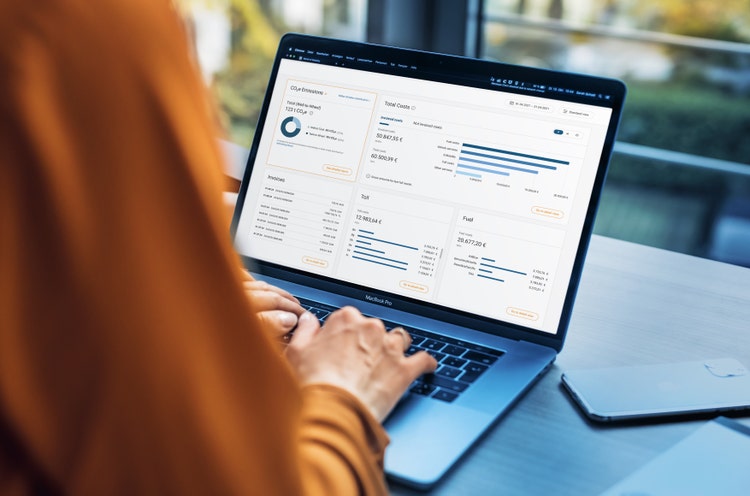
Intelligent tools can be a real help here. One example of this is the DKV Mobility Carbon Monitor.
The DKV Mobility Carbon Monitor at a glance
The DKV Mobility Carbon Monitor helps companies document the CO₂e emissions of their entire fleet and offers two key functions for this purpose:
- CO₂e emissions tracker: DKV Mobility customers receive detailed information about the emissions caused by each refueling or charging transaction made with a DKV card. The data can be exported for any period of time and enables precise and transparent documentation of fleet emissions.
- CO₂e annual report: Carbon Monitor generates an annual CO₂e report with a detailed fleet emissions balance sheet and a methodology report describing the data basis and calculation logic. Companies can use this report to fulfill their reporting obligations to their auditing firm.
Act early—it pays off!
Transparent recording of fleet emissions is becoming increasingly essential for companies. Smart tools not only provide them with accurate data on their fleet's CO₂e emissions, but also enable them to proactively prepare for future requirements. Those who opt for digital solutions now are laying the foundation for sustainable and future-proof fleet management.
For more information on the DKV Mobility Carbon Monitor, click here.
component-separator-start_readMoreButton
cta-white-blue-border
component-separator-end_readMoreButton