The DKV Carbon Monitor helps you record, analyze, and comply with CSRD reporting requirements for CO₂ equivalents (CO₂e).
{{"link": "#dkv_contact", "linkStyle": "cta", "linkTitle": "Request a non-binding offer now", "linkType": "jumpmark", "aria-label": "Request a non-binding offer now", "linkLabel": "Request a non-binding offer now", "target": "_self"}}

options-class__checkerboard
options-key__id
options-key__background-color
options-key__margin-top
options-key__margin-bottom
options-class__checkerboard-item
options-key__class-checkerboard-item-default
options-key__toggle-image-position-left
false
options-key__toggle-animation-enabled
component-class__checkerboard-item-container-text
component-separator-start_content-top
The challenge: New reporting obligations and more CO₂e transparency
Companies are under increasing pressure to accurately measure, record and report their CO₂e emissions.
The new CSRD reporting obligation (Corporate Sustainability Reporting Directive) in particular requires detailed insights into the CO₂e footprint - including along the entire supply chain.
component-separator-end_content-top
component-separator-start_content-bottom
component-separator-start_button
component-separator-end_button
component-separator-end_content-bottom
component-class__checkerboard-item-container-image
image

options-class__checkerboard-item
options-key__class-checkerboard-item-default
options-key__toggle-image-position-left
true
options-key__toggle-animation-enabled
component-class__checkerboard-item-container-text
component-separator-start_content-top
The solution: The DKV Carbon Monitor
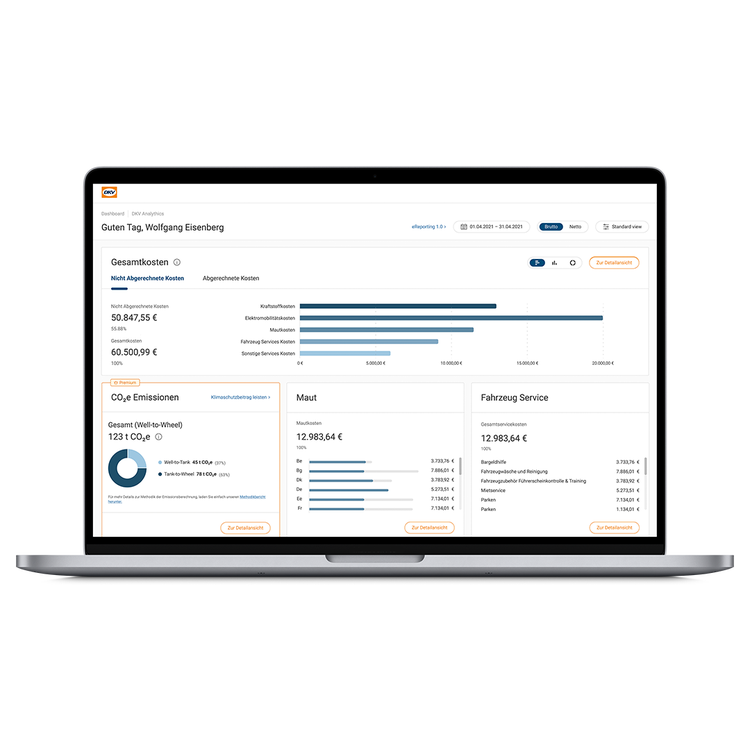
The DKV Mobility Carbon Monitor is the ideal solution for monitoring and documenting the CO₂e emissions of your fleet efficiently, precisely and automatically
Our CO₂e services give you a complete overview of the emissions of all fuels and charging processes - from fossil and alternative fuels to electric vehicles - and you can easily export the data.
component-separator-end_content-top
component-separator-start_content-bottom
component-separator-start_button
component-separator-end_button
component-separator-end_content-bottom
component-class__checkerboard-item-container-image
image
What is the CSRD reporting obligation?
The Corporate Sustainability Reporting Directive (CSRD) is an EU directive that obliges companies to report on their social and environmental impact and climate risks. The regulation is gradually affecting more and more companies, including suppliers to large corporations.
Who is subject to CSRD reporting?
The CSR reporting obligation applies to capital market-oriented companies, banks and insurance companies with more than 500 employees or a turnover of more than EUR 40 million or a balance sheet total of more than EUR 20 million. Suppliers could also be affected if large companies demand CSR data from them.
What are CO₂e (CO₂ equivalents)?
CO₂e summarizes the climate impact of all greenhouse gases in a single unit. This makes the effect of methane, nitrous oxide & co. comparable to carbon dioxide (CO₂), the main driver of global warming
{{"link": "#dkv_contact", "linkStyle": "cta", "linkTitle": "Further questions and answers on CSRD, CO\u2082e and co ", "linkType": "jumpmark", "aria-label": "Further questions and answers on CSRD, CO\u2082e and co ", "linkLabel": "Further questions and answers on CSRD, CO\u2082e and co ", "target": "_self"}}
Your benefits with the DKV Mobility Carbon Monitor
- Simple recording and documentation: Automated recording of CO₂e emissions for all fuels and loading units - all in one central location.
- Compliance with legal requirements: The DKV Mobility Carbon Monitor helps you meet the requirements of the Corporate Sustainability Reporting Directive (CSRD) and prepare for annual reporting.
- Increased transparency and control: Detailed emissions data that helps you keep an eye on your fleet's CO₂e emissions at all times and make targeted optimizations.
Functions of the DKV Mobility Carbon Monitor
CO₂e Emissions Tracker
Receive detailed information on the CO₂e emissions caused for each refueling and charging process and export the data for freely selectable time periods.
Annual CO₂e report
Receive a clearly structured annual report on your energy portfolio purchased with DKV Mobility, including a comprehensive fleet emissions overview and methodology report. Use this report as a basis for CSRD reporting and for cooperation with your auditor.
Now available: CO₂e Compare & Proof
Demonstrate your CO₂e impact in a transparent and comparable way — based on your actual refuelings. Create an official CO₂e impact statement for a freely selectable time period and a selected fuel type. The actual CO₂e emissions are automatically compared with the corresponding fossil or alternative equivalent (e.g. Diesel ↔ HVO100, LNG ↔ Bio-LNG) — in both directions.
Here you will find answers to frequently asked questions about the DKV Mobility Carbon Monitor
The DKV Mobility Carbon Monitor provides a transparent overview of:
- Well-to-Wheel (WTW): the entire system limit of your fleet emissions:
- Well-to-Tank (WTT): Emissions before refueling/charging
- Tank-to-Wheel (TTW): Emissions after refueling/charging
In the new CO₂e tracker, emissions are already broken down into well-to-tank (before refueling/charging) and tank-to-wheel (after refueling/charging) at transaction level. The time period for the transaction overview can be freely selected and exported.
The associated annual CO₂e report covers a calendar year (01.01. - 31.12.) and provides you with an official fleet emissions balance (well-to-wheel level) and an associated methodology report, which you can share with your auditing company, for example, to fulfill the reporting obligations under the CSRD. This report can be downloaded collectively for several customer numbers.
The calculator for determining savings potential visualizes the emission savings potential of alternative fuels and e-mobility compared to fossil fuels.
- Well-to-Tank (WTT): refers to the emissions generated during energy production, transportation and storage before the energy reaches the vehicle.
- Tank-to-Wheel (TTW): includes the emissions generated when energy is converted into kinetic energy in the vehicle.
- Well-to-Wheel (WTW): describes the entire life cycle emissions from energy generation to vehicle operation.
Recording the entire emissions chain is necessary for complete reporting and forms the basis for regulatory verification obligations, e.g. as part of the Corporate Sustainability Reporting Directive (CSRD).
Here you will find answers to frequently asked questions about the DKV Mobility Carbon Monitor in the context of CSRD reporting
The Corporate Sustainability Reporting Directive (CSRD) is a new EU directive that requires companies to report on the following points:
- Risks and opportunities in the area of social and environmental issues - also in relation to climate change
- Impact of their business activities on people and the environment
All companies listed on an EU-regulated market (with the exception of micro-enterprises) are covered by the new reporting obligation. This regulation applies at different times to different types of companies and will also directly affect German SMEs in the medium term.
Even if your company is not currently subject to the CSRD and is therefore directly obliged to report on the CO₂e balance, your larger customers could still require you to provide information on the CO₂e emissions of your transports if you provide logistics services for your customer.
This is because these companies must report on their Scope 3 emissions under the CSRD, which includes purchased logistics services. The ability to provide accurate data on your CO₂e emissions may therefore prove to be a competitive advantage for you in the coming years.
Here you will find answers to frequently asked questions about the DKV Mobility Carbon Monitor in the context of CSRD reporting
options-class__interactive-form
options-key__id
dkv_contact
options-key__toggle-column-seperator
options-key__background-color
bg-blue-dark
options-key__margin-top
margin-top-2xl
options-key__margin-bottom
margin-bottom-2xl
options-class__interactive-form-text-item
options-key__class-interactive-form-text-item
component-class__interactive-form-text-item-title
Request a personal consultation today!
component-class__interactive-form-text-item-text
Take the opportunity to find out more about the DKV Mobility Carbon Monitor and how it can help you to efficiently monitor and document your CO₂e emissions.