options-class__career-news
options-key__toggle-with-sharing
true
component-class__career-news-container-sharing
2026-06-01T12:00:00
Share
communications@dkv-mobility.com
component-separator-start_downloadContent
component-separator-end_downloadContent
component-class__career-news-container-image
Electrifying together: How connectivity is accelerating the transformation of logistics
component-class__career-news-container-text
The transition to sustainable mobility is one of the key challenges facing companies in the transport and logistics industry today. It requires investment, new processes, and above all, the willingness to embrace new approaches.
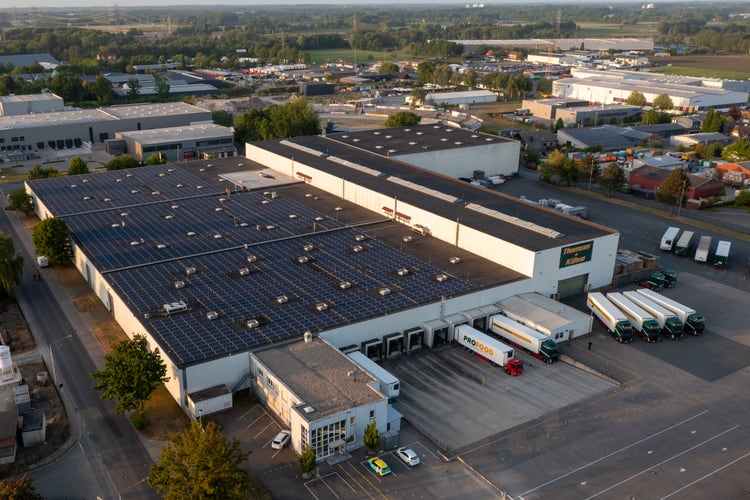
A practical example of how this transformation can succeed comes from the medium-sized logistics company Thomsen & Kühne from Cloppenburg, Germany. The company is gradually electrifying its fleet while relying on the strength of a connected ecosystem.
From self-generated energy to an electric fleet
Back in 2018, Thomsen & Kühne laid an important foundation by installing a photovoltaic system at its logistics site. Today, the company generates more electricity than it consumes itself – a key driver behind its decision to move towards electric mobility in transport operations as well.
“The very positive experiences we had and the fact that we now generate more energy than we consume encouraged us to take the next step towards e-mobility,” says Andreas Kühne, Managing Director at Thomsen & Kühne.
During initial testing phases, the company evaluated several electric trucks from different manufacturers. The driving experience quickly proved convincing – from the quiet ride to the significantly faster power delivery. At the same time, it became clear that the transition is a learning process rather than an overnight change.
Step-by-step transformation instead of radical change
One of Thomsen & Kühne’s key success factors was its structured approach. Rather than converting operations immediately on a large scale, the company focused on targeted testing phases and strong internal involvement.
“In the beginning, it was important for us to identify the right drivers for the test phase – people who would provide honest feedback – and to bring the entire team on board,” explains Kühne.
From fleet management to dispatching, all relevant departments were involved early on. Initially, this required detailed route planning, including the use of external charging stations. However, as experience grew, routine and confidence in the new technology quickly followed.
Charging Infrastructure: Combining own solutions with strong partnerships
Alongside vehicle procurement, Thomsen & Kühne also invested in its own charging infrastructure in order to make direct use of the self-generated electricity from its PV system. At the same time, everyday operations showed that public and semi-public charging infrastructure remains essential – particularly when flexibility is required.
This is where the strength of a connected ecosystem comes into play: Through DKV Mobility, Thomsen & Kühne gains access to a Europe-wide charging network, including tailored solutions for individual partnerships.
One example is the collaboration with a neighboring company from the Koopmann Group. Thomsen & Kühne can use Koopmann’s fast-charging infrastructure directly on their site.
'We are happy to use the Koopmann Group’s well-developed fast-charging infrastructure to increase our productivity through shorter charging times,” says Kühne.
What makes this particularly relevant is the fact that DKV Mobility enables individually agreed charging tariffs between both companies. Billing remains centralized and transparent via the familiar DKV Mobility invoice – regardless of who operates the charging infrastructure.
This so-called DKV Roaming@work solution allows companies to share charging infrastructure in a collaborative way without adding complexity to billing or pricing structures.
Connectivity as a key driver of transformation
For Thomsen & Kühne, one thing is clear: the energy transition can only succeed collectively.
“I fundamentally believe that the energy transition in our country will only succeed if many companies have the courage to actively participate,” reflects Kühne.
The exchange of knowledge and collaboration with partners, neighboring businesses, and industry networks plays a crucial role in this process. In a sector that heavily depends on cooperation, this creates new synergies and innovative solutions.
From DKV Mobility’s perspective, this example also highlights an important trend: the future of mobility is connected. Beyond infrastructure and technology, it is flexible and integrated solutions that help companies accelerate their transition – from fuel and charging cards to customized billing models.
Sustainability as a competitive advantage
In addition to operational benefits, sustainability is becoming increasingly important from a customer perspective. Thomsen & Kühne already provides CO₂ reporting for individual transports – a clear competitive advantage, especially as many customers are actively requesting sustainability concepts.
As a result, fleet electrification is not only a contribution to climate protection, but also a strategic investment in future competitiveness.
Conclusion: Moving forward together
The example of Thomsen & Kühne demonstrates that the path toward an electric fleet is not always linear – but it is achievable.
By combining proprietary infrastructure, practical testing, and strong partnerships, challenges can be addressed step by step. Above all, the example highlights the importance of connectivity: when companies share charging infrastructure, exchange expertise, and rely on integrated solutions, an ecosystem emerges that significantly accelerates the transformation process.
Or, as Andreas Kühne puts it: 'Transformation begins where companies have the courage to actively shape it.'
component-separator-start_readMoreButton
cta-white-blue-border
component-separator-end_readMoreButton