options-class__career-news
options-key__toggle-with-sharing
true
component-class__career-news-container-sharing
2025-10-20T12:30:00
Share
newsroom@dkv-mobility.com
component-separator-start_downloadContent
component-separator-end_downloadContent
component-class__career-news-container-image
Smart charging: optimally charge company vehicles and save costs
component-class__career-news-container-text
More and more companies are turning to electric vehicles to achieve their climate goals. Tax advantages are also contributing to the growing popularity of electric cars as company and business vehicles. But EVs need to be charged, and this puts pressure on local grids.
When numerous vehicles roll into a company parking lot or underground garage at the same time in the morning and need to be charged throughout the working day, this can lead to bottlenecks and overload the power grid.
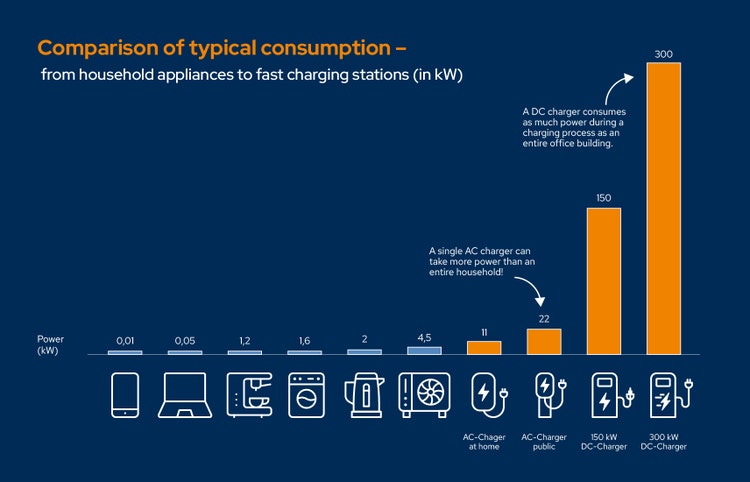
To put that demand into perspective: even a single AC charger with a charging capacity of up to 22 kW can exhaust the entire capacity of a conventional house connection. A DC-fast-charger with up to 300 kW requires as much power as an entire office building during peak load times. Most existing electrical installations are not designed for this additional load.
component-separator-start_readMoreButton
cta-white-blue-border
component-separator-end_readMoreButton
options-class__career-news
options-key__toggle-with-sharing
false
component-class__career-news-container-sharing
2025-04-26T10:30:00.000Z
Share
sdkljfnsdf@asdfklmsdf.com
component-separator-start_downloadContent
component-separator-end_downloadContent
component-class__career-news-container-image
component-class__career-news-container-text
A common way to deal with this is to upgrade the grid connection with bigger cables, and higher capacity infrastructure. But this is expensive, time-consuming, and in some regions, such as the Netherlands, not even possible due to constraints from the grid operator.
The good news: most EVs don’t need to charge at full power the entire day. Few employees drive hundreds of kilometers to the office every morning. Often, EVs only need a modest top-up during working hours. This means there are smarter, more efficient ways to manage 10 charging stations, while not overloading the local grid.
Intelligent control
Smart charging, i.e, intelligent control charging rates, offers a pragmatic, resource- and cost-saving solution here. The aim is to make optimum use of available electricity capacity while avoiding grid overloads. Instead of assigning each EV maximum power at once, smart charging distributes the electricity dynamically using algorithms. These algorithms can prioritize EVs that have just arrived at a car park and reduce power to those that are already fully charged. It can even consider how much electricity the office building itself is consuming. For example, if the office consumes high amounts of electricity at lunchtime, smart charging can automatically reserve less capacity for the charging stations to avoid overload of the local grid.
Priority for urgent departures
Individual charging sessions can be prioritized: vehicles that are about to depart, for example, receive more power than cars parked for longer periods, such as several hours or overnight. Charging sessions can also be specifically postponed to times when electricity tariffs are lower. “For employees who park their company cars in the garage in the morning, it usually doesn't matter whether the charging process takes two or eight hours, or whether it starts immediately or later. The main thing is that the battery is full in the evening. On the other hand, those who must leave for an appointment at short notice are allocated more charging power by the system and can then set off without worrying their battery has insufficient power,” says eMobility expert Bob Elders, Product Manager at GreenFlux.
Charge when it's cheapest
Smart charging offers fleet operators another economic advantage: the opportunity to benefit from dynamic energy prices. For example, charging can be done cheaply at night and power consumption reduced during peak times during the day when tariffs are high. Companies with solar panels can take smart charging a step further by aligning EV charging with their own energy production. Charge rates of EVs can be increased when the sun is shining and solar panels generate plenty of electricity, allowing for maximal use of locally produced energy.
Future-proof solution
Smart Charging can be managed either locally or via a cloud. Cloud-based solutions that use open communication protocols and work with different charging station manufacturers offer clear advantages: they’re easy to set up, highly flexible, require low maintenance, and are future-proof.
The bottom line is that smart charging enables companies to make maximum and sustainable use of their existing or planned charging infrastructure – at minimal cost and without having to purchase oversized, expensive systems.
You can find more information on smart charging here.
component-separator-start_readMoreButton
cta-white-blue-border
component-separator-end_readMoreButton