Natural gas (LNG, CNG) fuel
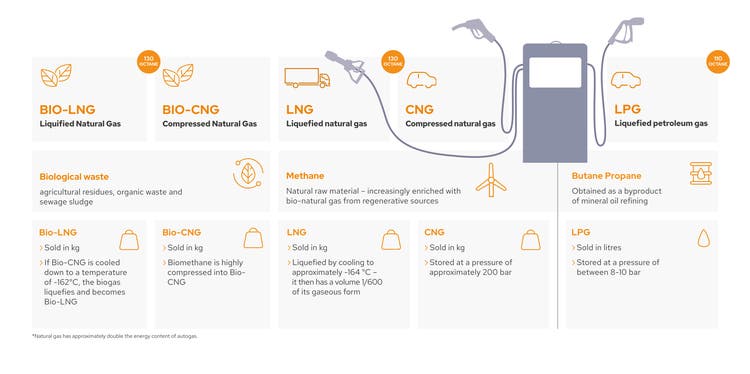
LNG (liquified natural gas) is a liquefied gas that is inherently odourless, non-corrosive and non-toxic. It consists of methane, ethane, propane and other hydrocarbons. For this reason, LNG is particularly suitable for long-distance transport.
When refuelling LNG, the laws and regulations governing the refuelling process must be observed. These may be at European or national level and may vary depending on the operator. It is the driver's responsibility to find out in advance.
CNG (compressed natural gas) is a compressed natural gas with an increasing proportion of biogas and a high calorific value.
Are you looking for a filling station near you where you can refuel CNG or LNG as a DKV Mobility customer? {{"link": "https://my.dkv-mobility.com/maps/", "linkStyle": "default", "linkTitle": "DKV Maps", "linkType": "external", "aria-label": "DKV Maps", "linkLabel": "DKV Maps", "target": "_blank"}} shows you the nearest one. There are 700 LNG stations in the EU, with more than 600 in the DKV network. For CNG, 4,200 stations are available in the EU, with more than 2,180 in the DKV network.
Advantages of LNG and CNG
- Natural gas is more cost-effective than diesel (tax benefits)
- Refuelling takes no longer than with petrol or diesel
- Engine noise is reduced
- Emissions of sulfur dioxide, soot, and other particulates are almost completely avoided
- Natural gas causes up to 23 percent less CO₂
Refueling with Bio-LNG and Bio-CNG
Advantages of Bio-CNG and Bio-LNG
- With 100% Bio-CNG, up to 90% of CO₂e emissions can be saved compared to fossil CNG, and with 100% Bio-LNG, up to 87% of CO₂e emissions can be saved compared to fossil LNG (Well-to-Wheel).
- Bio-LNG is independent of natural gas prices, leading to significantly higher price stability.
- Refueling with Bio-CNG and Bio-LNG takes no longer than refueling with gasoline or diesel.
- Vehicles running on Bio-LNG generate about 75% less engine noise compared to diesel vehicles.
- Compared to diesel vehicles, Bio-CNG and Bio-LNG reduce particulate emissions by approximately 95%. In addition, sulfur and nitrogen oxide emissions are almost completely avoided.
Are you looking for a filling station near you where you, as a DKV Mobility customer, can refuel with Bio-CNG or Bio-LNG? DKV Maps shows you the nearest station for Bio-CNG and Bio-LNG.
Autogas (LPG) fuel
LPG (liquified petroleum gas) is a byproduct of oil refineries. Autogas is the most readily available alternative fuel.
Are you looking for a filling station near you where you can refuel DKV Mobility LPG? {{"link": "https://my.dkv-mobility.com/maps/", "linkStyle": "default", "linkTitle": "DKV Maps", "linkType": "external", "aria-label": "DKV Maps", "linkLabel": "DKV Maps", "target": "_blank"}} shows you the nearest location.There are 48,215 LPG stations in the EU, with more than 17,900 in the DKV network.

Advantages of Autogas (LPG):
- Autogas is much cheaper than conventional diesel or petrol
- When it combusts, it creates much less pollution than conventional
- Fuels, which results in lower exhaust emissions
Fueling Hydrogen
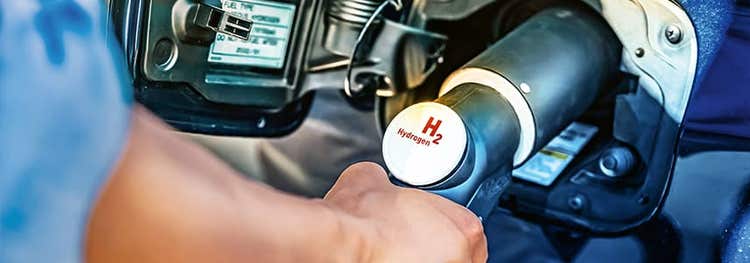
Hydrogen is a refrigerated fuel and refuelling takes place under high pressure. In the vehicle’s fuel cell, hydrogen combines with oxygen from the atmosphere, which releases energy. All that comes out of the exhaust is water in the form of water vapour.
We plan to make increasing numbers of hydrogen fuel stations available in the DKV Mobility network in the coming years.
Are you a DKV customer looking for a nearby fuel station to refuel with AdBlue, LNG or LPG? {{"link": "https://my.dkv-mobility.com/maps/", "linkStyle": "default", "linkTitle": "DKV Maps ", "linkType": "external", "aria-label": "DKV Maps ", "linkLabel": "DKV Maps ", "target": "_blank"}}shows you your nearest station. There are 300 hydrogen stations in the EU, with 80 in the DKV network.
Filling up with AdBlue
AdBlue is a liquid that reduces emissions of damaging NOx and soot particles from modern diesel engines. An additional in-built catalytic converter uses AdBlue to change NOx into water vapour and nitrogen. AdBlue helps vehicles meet the emission standards applicable in Europe. AdBlue consists of 67.5 % demineralised water and 32.5% urea. It is non-toxic and almost odourless.
Are you a DKV Mobility customer wanting to find a nearby fuel station to fill your alternative fuel tanks? Then click on the link {{"link": "https://my.dkv-mobility.com/maps/", "linkStyle": "default", "linkTitle": "DKV Maps", "linkType": "external", "aria-label": "DKV Maps", "linkLabel": "DKV Maps", "target": "_blank"}} to go to our station finder. There are 50,000 AdBlue stations in the EU, with more than 46,500 in the DKV network.

HVO refueling - sustainability for your fleet

Map of our HVO100 stations
Here you can find {{"link": "https://my.dkv-mobility.com/maps/", "linkStyle": "default", "linkTitle": "a map of our HVO100 stations", "linkType": "external", "aria-label": "a map of our HVO100 stations", "linkLabel": "a map of our HVO100 stations", "target": "_blank"}}(currently approx. 3,000 in Europe [as of december 2025]). Are you looking for a gas station in your area where you can refuel with HVO as a DKV Mobility customer? DKV Maps will show you the nearest station. There are 5,000 HVO stations in the EU, with 2,755 in the DKV network.
Possible uses of HVO
HVO can be used in many different ways: it can be added (e.g. HVO20 or HVO30) to diesel fuels or used on its own as a fuel (HVO100).
As a drop-in solution capable of being used directly in vehicles, HVO is an ideal option for existing vehicle fleets. HVO fulfils the provisions of DIN 590 for diesel fuels (apart from density). Most vehicles require no adjustments to the engine or the fuel distribution system.
HVO100: a more environmentally friendly fuel for modern engines
HVO100 and other purely paraffinic fuels are subject to the provisions of DIN EN 15940 and can generally be used without problems in newer diesel engines.
Many manufacturers of heavy commercial vehicles or diesel trucks have approved HVO100 for use in their engines.
For further information, please contact the relevant vehicle manufacturer.
Comparison with conventional diesel
The consumption per km figures for HVO and fossil diesel are practically identical.
Even though HVO is generally more expensive than conventional diesel, it can offer a financial advantage if you have to demonstrate a more sustainable transport policy to your customers.
Advantages of hydrogenated vegetable oils (HVO)
- Reductions in greenhouse gas emissions of up to 90 % over the whole product lifecycle (well-to-wheel) as well as reduced noise, nitrogen oxides, fine dust particles, carbon dioxide and hydrocarbon emissions
- Winterised and cold-resistant down to -22 °C
- Combustion produces much lower soot emissions
- Resistant to microbial growth and attack by microorganisms (the "diesel bug")
- Hardly susceptible to ageing compared to fossil diesel
- Extremely compatible with existing systems and therefore no upgrading or conversion of vehicles is required

options-class__interactive-form
options-key__id
dkv_contact
options-key__toggle-column-seperator
options-key__background-color
bg-blue-dark
options-key__margin-top
margin-top-2xl
options-key__margin-bottom
margin-bottom-2xl
options-class__interactive-form-text-item
options-key__class-interactive-form-text-item
component-class__interactive-form-text-item-title
Contact
component-class__interactive-form-text-item-text
Would you also like to benefit from the DKV Mobility advantages?
We will be pleased to call you back.